


[Lecture Report] Global Health Training 2025 Panel Discussion — Shaping Health Policy in the Era of Climate Change — (AMSA International, October 24, 2025, Online)
date : 10/25/2025
Tags: Global Health Human Resources Development, Planetary Health

![[Lecture Report] Global Health Training 2025 Panel Discussion — Shaping Health Policy in the Era of Climate Change — (AMSA International, October 24, 2025, Online)](https://hgpi.org/en/wp-content/uploads/sites/2/eyecatch_sugawara-3-13.png)
On October 24, 2025, Mr. Joji Sugawara, Vice President of Health and Global Policy Institute (HGPI), participated as a panelist in the session titled “Shaping Health Policy in the Era of Climate Change” at the AMSA International Global Health Training 2025, organized by the Asian Medical Students’ Association (AMSA).
AMSA is an international network of medical students that focuses on strengthening human connections across Asia with the aim of improving medicine and public health in the region. Under the slogan “Let’s connect now for the future,” AMSA promotes the development of future healthcare leaders through activities led by its national and regional chapters
In Japan, AMSA Japan facilitates connections among medical students through workshops, residential medical training programs, article writing, and the publication of a bilingual eNewsletter. Internationally, AMSA engages in short-term exchange programs within Asia, participation in international conferences, and collaborative events among member countries.
The Global Health Training 2025 was held under the theme “Empowering Medical Students in Policy through Policy Brief Workshop.” The two-day program aimed to equip medical students with practical skills to engage in health policy-making and advocacy beyond clinical practice, with a particular focus on climate change and health. Participants developed and presented evidence-informed policy briefs as part of the training.
During the panel discussion, participants engaged in a global dialogue on the health impacts of climate change and the role of health and healthcare policies in responding to these challenges.
Panelists
- Jeni Miller (Executive Director, Global Climate and Health Alliance)
- Joji Sugawara (Vice President, Health and Global Policy Institute)
- Ayunda Dewi Jayanti Jilan Putri (Medical Doctor / Public Health Researcher)
In particular, the discussion highlighted:
- Global policy trends at the intersection of climate change and health
- How scientific evidence can be translated into political decision-making
- The roles that medical students and early-career health professionals can play in policy and advocacy
Drawing on his experience in health policy and global health diplomacy in Japan, Mr. Sugawara emphasized that climate change and health are cross-cutting issues that extend beyond the healthcare sector to encompass the environment, economy, energy, and foreign policy, and that the involvement of health professionals in policy discussions will become increasingly important. He also emphasized that, in order to ensure that evidence is effectively reflected in policy, it is essential not only to generate robust research outcomes, but also to understand the perspectives of policymakers and the broader public, and to communicate findings in a clear and accessible manner tailored to those audiences.
These discussions closely align with HGPI’s work on Planetary Health. HGPI is a member of the Global Climate and Health Alliance (GCHA) and collaborates with international partners to promote health-centered climate policies. The session provided an opportunity to connect global policy discussions with the practical learning experiences of the next generation of medical professionals.
In the latter part of the session, student groups presented their draft policy briefs, and panelists, including Mr. Sugawara, offered constructive feedback on the use of evidence, clarity of policy recommendations, and feasibility of proposed actions.
HGPI remains committed to working with student organizations such as AMSA Japan and with early-career professionals to foster an environment in which the next generation of healthcare leaders can actively and meaningfully participate in health policy-making at both national and global levels.
Related Posts
-
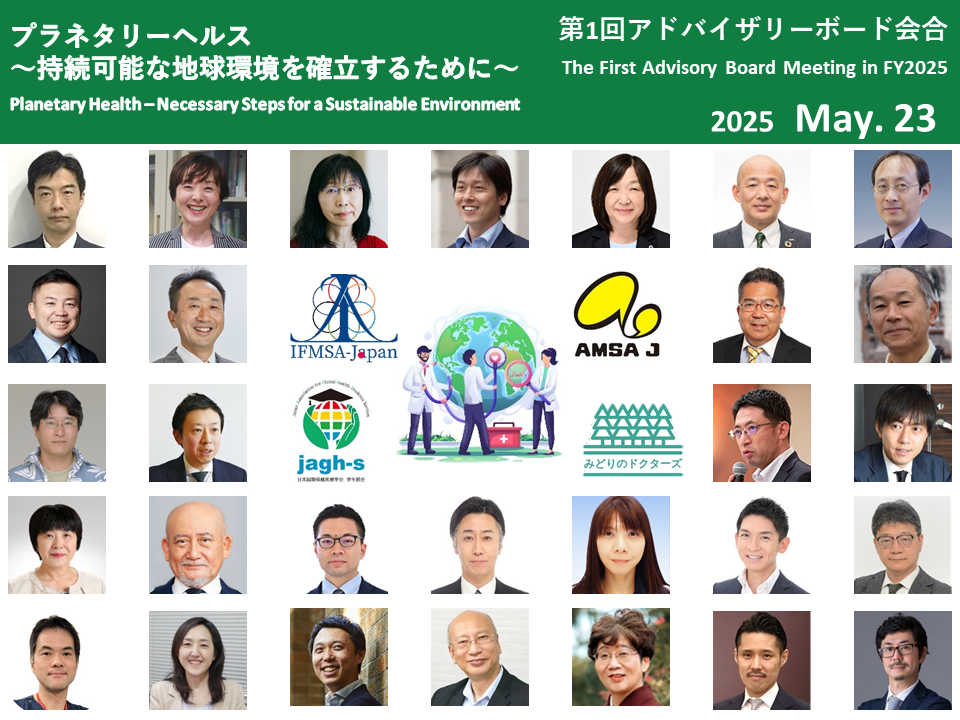
2025-06-03
[Event Report] Planetary Health Project: “Planetary Health—Establishing a Sustainable Earth's Environment” First Advisory Board Meeting of FY2025 (May 23, 2025)
-
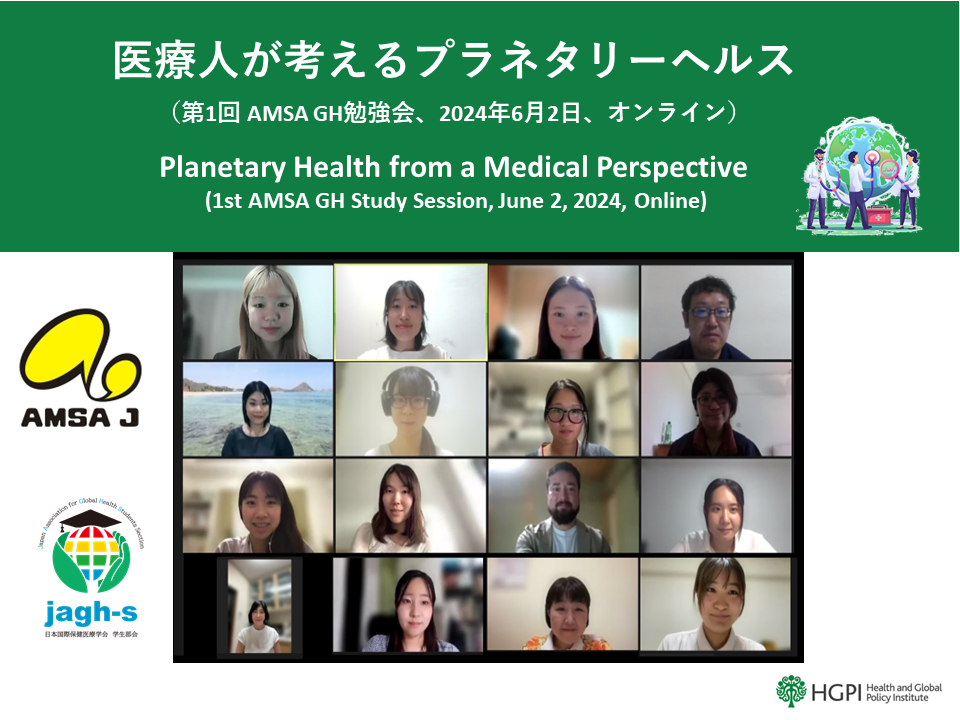
2024-06-04
[Lecture Report] "Planetary Health from a Medical Perspective" (1st AMSA GH Study Session, June 2, 2024, Online)
-
2024-04-12
[Announcement] HGPI Joins Global Climate and Health Alliance (March 23, 2024)
-
2023-07-03
[Announcement] Youth Organizations Join Planetary Health Project (July 3, 2023)
Top Research & Recommendations Posts
- [Research Report] Perceptions, Knowledge, Actions and Perspectives of Healthcare Organizations in Japan in Relation to Climate Change and Health: A Cross-Sectional Study (November 13, 2025)
- [Research Report] The 2025 Public Opinion Survey on Healthcare in Japan (March 17, 2025)
- [Policy Recommendations] Developing a National Health and Climate Strategy for Japan (June 26, 2024)
- [Policy Recommendations] Mental Health Project: Recommendations on Three Issues in the Area of Mental Health (July 4, 2025)
- [Announcement] HGPI Endorses the “Belém Health Action Plan” (November 14, 2025)
- [Research Report] The 2023 Public Opinion Survey on Satisfaction in Healthcare in Japan and Healthcare Applications of Generative AI (January 11, 2024)
- [Publication Report] Planetary Health Promotion Project “Issues Facing Planetary Health and the Role of the Health Sector” (May 10, 2023)
- [Announcement] HGPI Joins Global Green and Healthy Hospitals (August 1, 2023)
- [Research Report] Survey of Japanese Physicians Regarding Climate Change and Health (December 3, 2023)
- [Public Comment Submission] “Interim Evaluation of the Implementation Status of the National Biodiversity Strategy 2023-2030 (Draft)” and the “7th National Report under the Convention on Biological Diversity (Draft)” (December 2, 2025)
Featured Posts
-
2025-12-11
[Event Report] Core Components of Universal Health Coverage (UHC): Achieving “Healthcare Without Financial Hardship” in Asia-Pacific and Japan (December 5, 2025)
![[Event Report] Core Components of Universal Health Coverage (UHC): Achieving “Healthcare Without Financial Hardship” in Asia-Pacific and Japan (December 5, 2025)](https://hgpi.org/en/wp-content/uploads/sites/2/HGPI_20251210_Core-Components-of-Universal-Health-CoverageUHC-top.jpg)
-
2025-12-12
[Registration Open] Meaningful Involvement Promotion Project Urgent Symposium “The New Takaichi Administration and Central Social Insurance Medical Council Reform – Ensuring Patients’ Voices are Heard” (January 22, 2026)
![[Registration Open] Meaningful Involvement Promotion Project Urgent Symposium “The New Takaichi Administration and Central Social Insurance Medical Council Reform – Ensuring Patients’ Voices are Heard” (January 22, 2026)](https://hgpi.org/en/wp-content/uploads/sites/2/HGPI_20251208_urgent-symposium-1.png)
-
2025-12-12
[Registration Open] (Webinar) The 140th HGPI Seminar “Early Detection to Reduce COPD Disease Burden: Connecting Clinical Frontiers with Health Policy” (January 27, 2026)
![[Registration Open] (Webinar) The 140th HGPI Seminar “Early Detection to Reduce COPD Disease Burden: Connecting Clinical Frontiers with Health Policy” (January 27, 2026)](https://hgpi.org/en/wp-content/uploads/sites/2/hs140-top.png)
